
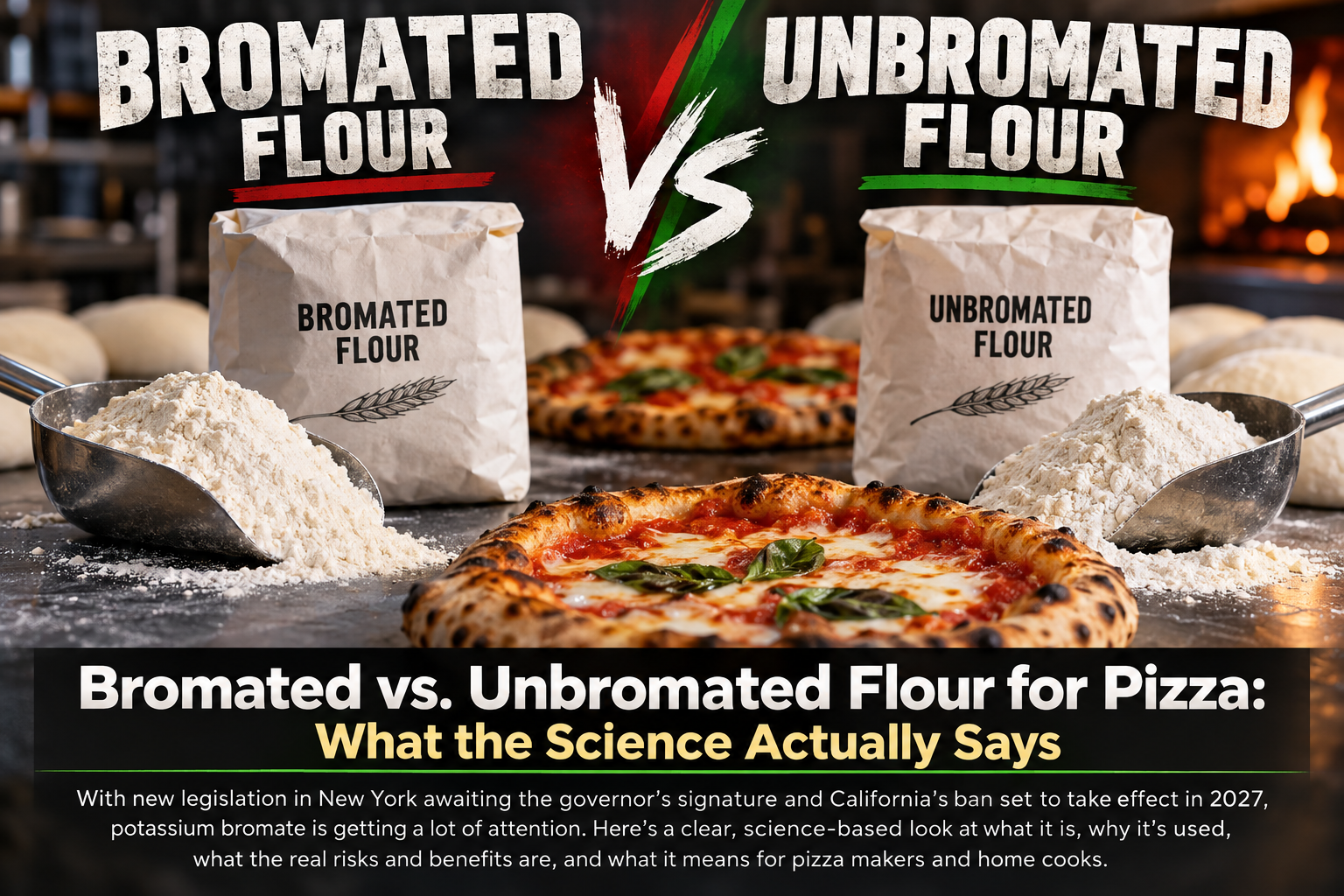
Why I Decided to Dig Into Bromated Flour
The reason I started going after this subject was not because bromated flour suddenly appeared in the food supply. Bakers and pizza makers have been using it for decades.
What changed was the amount of attention surrounding it.
California passed legislation prohibiting potassium bromate in foods sold in the state beginning January 1, 2027. More recently, New York lawmakers passed the Food Safety and Chemical Disclosure Act, S1239F/A1556G, which also includes potassium bromate among the additives it would prohibit. As of September 24, 2026, the New York bill has passed both the Senate and Assembly and is awaiting action by Governor Kathy Hochul. Because it has not yet been signed, there is not a fixed calendar date for the New York prohibition. (Governor of California)
Watching two enormous food markets move in the same direction made me wonder whether we were looking at the beginning of a much broader change. Even without a federal prohibition, manufacturers that sell nationally do not necessarily want separate formulas for California, New York, and the rest of the country. A couple of major state laws can have consequences far beyond their borders.
At the same time, I kept hearing friends, bakers, pizza professionals, and people throughout the industry talking about bromated flour.
Some said it was dangerous.
Others said it was completely harmless because it all disappeared in the oven.
Others insisted that New York pizza could never be the same without it.
A lot of what I was hearing sounded less like settled science and more like speculation repeated often enough that it had become accepted as fact.
Then you go online and things get worse.
Depending on which “expert” you find first, potassium bromate is either poisoning America or another example of people becoming unnecessarily afraid of perfectly safe food chemistry.
I did not want to add another opinion to that pile.
I wanted to dig into the chemistry, toxicology, baking science, regulatory history, and actual function of potassium bromate and put everything in one place.
The goal of this article is not to scare anyone into changing flour tomorrow. It is also not to defend bromated flour simply because the baking industry has used it successfully for generations.
It is to give pizza makers, bakers, and consumers something comprehensive they can reference when the next headline or social-media expert tells them what they are supposed to believe.
So let’s look at what the science actually says.
What Is Potassium Bromate?
Potassium bromate, KBrO₃, is a strong oxidizing agent that has historically been used as a flour treatment and dough strengthener.
Its job is not to make flour cheaper, preserve it indefinitely, or disguise bad ingredients.
Its primary purpose is functional.
In wheat dough, oxidation affects sulfhydryl groups within the protein system and encourages stronger disulfide bonding. In practical terms, that can reinforce the gluten network and improve the dough’s ability to retain gas and maintain structure through fermentation, handling, and baking. (NYSenate.gov)
For a baker, that can translate into:
- stronger dough
- greater fermentation tolerance
- better gas retention
- improved oven spring
- greater mixing and processing tolerance
- more consistent finished products
For someone making a dozen pizzas at home, a little variation may not matter much.
For a commercial bakery or pizzeria trying to produce the same product through hundreds or thousands of dough balls, process tolerance has tremendous value.
That is one reason potassium bromate lasted as long as it did.
It works.
Current federal standards still recognize bromated flour and permit potassium bromate within specified limits, including a maximum addition level of 50 parts per million under the applicable flour standard. (NYSenate.gov)
So as of this writing, potassium bromate is not prohibited nationwide in the United States.
That does not mean the scientific discussion ends there.
Why Pizza Makers Have Liked Bromated Flour
Pizza dough is not just a recipe.
It is a processing system.
A dough ball might be mixed on Tuesday, refrigerated for days, transported, removed from refrigeration, warmed, stretched, topped, launched, and baked during a busy Friday night service.
During that entire process, the gluten network is changing.
Fermentation and enzymatic activity gradually alter and relax the dough. Meanwhile, the pizza maker still needs enough strength for the dough to survive stretching and launching without tearing or becoming excessively slack.
A strong high-gluten flour helps.
Oxidation can strengthen the system further.
Potassium bromate became particularly valuable because its strengthening action occurs relatively late in dough processing compared with some other oxidizing systems.
That gives the baker another layer of tolerance as the dough travels through fermentation and eventually into the oven.
Commercial food production loves process tolerance.
If the dough remains usable for another hour during a dinner rush, that matters.
If it tolerates small variations in fermentation, mixing, or handling without becoming unusable, that matters.
That is why strong bromated flours became so closely associated with commercial bread baking and many New York-style pizza operations.
So Is Potassium Bromate a Carcinogen?
This is where terminology starts getting abused.
The International Agency for Research on Cancer, or IARC, classifies potassium bromate as Group 2B, possibly carcinogenic to humans.
That classification is based substantially on evidence from experimental animals. Direct evidence of carcinogenicity in humans is inadequate.
Researchers have also identified concerns involving oxidative stress, DNA damage, and genotoxicity.
That is legitimate toxicological evidence.
It should not be ignored.
But the classification also does not mean scientists have demonstrated that eating a slice of pizza made with properly used bromated flour causes cancer.
Those are two very different statements.
Unfortunately, social media tends not to reward distinctions like that.
Does Bromate “Cook Out”?
This may be the most misunderstood part of the discussion.
You will frequently hear:
“Don’t worry about bromate. It cooks out.”
That is convenient shorthand, but chemically it is incomplete.
Potassium bromate is intended to participate in oxidation reactions throughout dough processing and baking. During those reactions, bromate is largely converted into bromide, which is a chemically different species.
Classic baking research has shown that bread manufactured with appropriate bromate levels and processing conditions can contain bromate below analytical detection after baking.
Research has also shown that as potassium bromate addition increases, detectable residual bromate becomes more likely.
That distinction matters.
Another interesting finding from the baking literature is that simply heating potassium bromate by itself does not tell the whole story. Components of the dough, including the gluten system, participate in reactions responsible for reducing bromate during breadmaking.
So a more scientifically accurate statement is:
Under appropriate formulation and processing conditions, potassium bromate is intended to react during dough processing and baking and be converted largely to bromide before the finished product is consumed.
That is different from:
The oven burns it all off.
Residual Bromate Is the Question That Really Matters
This is where the discussion becomes much more useful.
If potassium bromate reacts as intended and the finished product contains no meaningful residual bromate, consumer exposure is very different from a product in which measurable bromate remains.
Published baking studies have demonstrated very low or undetectable residual bromate under certain formulation and processing conditions.
They have also demonstrated that excessive bromate use can result in residual bromate.
That means several variables potentially matter:
- bromate concentration
- flour composition
- dough chemistry
- fermentation
- product thickness
- baking temperature
- baking time
- moisture
- analytical detection limits
And this is where I think pizza deserves some additional consideration.
A large portion of the classic literature involves bread.
A loaf of bread might spend 20, 30, or even 40 minutes in an oven.
A New York-style pizza might bake in several minutes.
A high-temperature pizza could bake in 60 to 120 seconds.
Those are not equivalent thermal processes.
The underlying chemistry does not suddenly become irrelevant, but I would be very careful taking residual-bromate results from a conventional loaf of bread and automatically declaring that they describe what happens inside every pizza crust.
This is precisely where good food science requires us to distinguish what has actually been measured from what we are assuming.
Why Are Governments Treating Bromate Differently?
Different governments have reached different regulatory conclusions about potassium bromate.
The United States continues to permit it federally under specified conditions.
California took a different approach with Assembly Bill 418. Governor Gavin Newsom signed the legislation on October 7, 2023, and foods covered by the law may not contain potassium bromate when the prohibition takes effect on January 1, 2027. (Governor of California)
New York is now considering a similar path.
The state’s Food Safety and Chemical Disclosure Act passed both chambers of the Legislature in 2026. The legislation includes potassium bromate, Red No. 3, and propylparaben among the additives it would prohibit. As of September 24, 2026, it awaits action by Governor Hochul. (NYSenate.gov)
The bill’s final text does not create an immediate ban upon signing. It provides a staged implementation period after the legislation becomes law. Because the governor has not yet acted, there is currently no exact New York calendar date to put on the prohibition. (NYSenate.gov)
Other countries have also restricted or prohibited potassium bromate.
Does that automatically prove one regulatory system is right and another is wrong?
No.
Food regulation involves more than determining whether a substance can produce harm at some exposure.
Regulators also consider exposure, dose, uncertainty, technological need, available alternatives, enforcement, analytical capabilities, and acceptable margins of safety.
And in the case of bromate, there are alternatives.
That changes the discussion.
What Happens When You Switch to Unbromated Flour?
Removing bromate does not make great pizza impossible.
Not even close.
It may simply require you to understand your process better.
Unbromated flour can require somewhat different mixing or fermentation management depending on the flour, protein level, treatment system, and dough formula.
Commercial bakers compensate in several ways.
Adjust Mixing
An unbromated flour may require somewhat different gluten development to achieve the characteristics you want.
Do not blindly add mixing time.
Watch final dough temperature.
Mechanical mixing generates heat, so changing mixing intensity may also require changing water temperature, mixer speed, or development targets.
Control Fermentation
Good fermentation management can overcome an enormous number of supposed flour problems.
Temperature, yeast level, dough maturity, balling time, refrigeration, and warm-up all matter.
A beautifully controlled unbromated dough will outperform a poorly controlled bromated dough every day of the week.
Consider Ascorbic Acid
Ascorbic acid, better known as vitamin C, is widely used as part of modern flour improvement systems and can contribute oxidative strengthening through a different pathway.
It has long been used as one alternative when manufacturers move away from bromate.
Commercial systems may also use enzymes and other ingredients to manage strength, extensibility, volume, handling, and fermentation tolerance.
This is why I caution people against looking for a single magic replacement.
Formulation is a system.
Take one ingredient away and you evaluate what the entire system needs afterward.
Bromated vs. Unbromated Flour in the Pizza Kitchen
| Characteristic | Bromated flour | Unbromated flour |
|---|---|---|
| Dough strength | Very strong | Can also be very strong |
| Fermentation tolerance | Generally excellent | Depends more heavily on flour and process |
| Processing tolerance | Very forgiving | May require tighter process control |
| Oxidative strengthening | Strong, including later in processing | Depends on flour treatment and formulation |
| Long cold fermentation | Historically very reliable | Excellent when properly formulated |
| Clean-label perception | Lower | Higher |
| Regulatory outlook | Increasing restrictions at state and international levels | Broadly accepted |
| Pizza quality potential | Excellent | Excellent |
That final comparison matters most.
You can make excellent pizza with either flour.
Potassium bromate is a processing tool.
It is not a prerequisite for good pizza.
Myth vs. Fact
Myth: Bromated flour is basically Roundup or some Monsanto chemical being hidden in pizza.
Fact: Potassium bromate is a specific inorganic oxidizing compound historically used as a dough improver. It has nothing chemically to do with glyphosate.
Myth: Bromated flour has been proven to give people cancer.
Fact: Potassium bromate has demonstrated carcinogenic activity in experimental animals. Evidence demonstrating human carcinogenicity is inadequate, which is an important distinction.
Myth: Bromate is completely harmless because it burns off in the oven.
Fact: Proper processing can reduce bromate substantially and convert it largely to bromide. However, residual bromate can occur depending upon use level and processing conditions.
Myth: If bromate were dangerous, the FDA would have banned it already.
Fact: Regulatory decisions involve hazard, exposure, existing law, available data, policy, and acceptable risk. FDA authorization does not mean a substance is incapable of causing harm under any condition.
Myth: If California banned it, bromated flour must be extremely dangerous.
Fact: California chose a more precautionary regulatory approach. A prohibition alone does not quantify the risk associated with a particular serving of food.
Myth: You cannot make authentic New York-style pizza without bromated flour.
Fact: You absolutely can.
Flour strength, protein quality, oxidation, hydration, mixing, fermentation, temperature, handling, and baking conditions all contribute to the final crust.
Where I Land After Looking at the Science
So after all of this, do I think every pizza maker using bromated flour needs to panic and swap it out immediately?
No.
That is not where the evidence takes me.
I do not believe someone should throw away a bag of flour tomorrow because a headline frightened them.
At the same time, I am not interested in defending an ingredient forever simply because our industry has successfully used it for 50 or 75 years.
If an ingredient raises legitimate toxicological questions, if some uncertainties remain, and if practical alternatives can produce the same quality product, I think it is reasonable to keep asking whether we still need it.
That is not fear.
That is progress.
Food science should work that way.
Our understanding changes.
Testing improves.
Analytical equipment gets better.
Researchers ask questions that were not being asked 50 years ago.
We have seen the same evolution in discussions surrounding food dyes, preservatives, contaminants, packaging materials, processing techniques, and countless other parts of the food system.
We know things today that we did not know several generations ago.
That does not mean everything our parents ate was dangerous.
It means knowledge moves forward.
I remember hearing my parents talk about a time when advertisements showed doctors in white coats reassuring people about cigarettes.
Today that seems unbelievable.
At the time, many consumers saw an authority figure and assumed the question had been settled.
There is a lesson in that which extends far beyond cigarettes.
Authority should not end curiosity.
Neither should tradition.
And neither should a viral social-media post.
Always ask where the information came from.
Look at the actual research when you can.
Ask who funded it.
Understand what was actually tested.
Pay attention to the dose.
Pay attention to whether the research involved humans, animals, cells, or theoretical exposure.
Look at whether someone is discussing a hazard or an actual risk at the exposure level consumers encounter.
And ask who benefits from the conclusion being presented to you.
That scrutiny should apply equally to someone selling you fear and someone selling you reassurance.
For me, bromated flour falls somewhere in that middle ground.
Do I believe the evidence supports panic?
No.
Would I personally be open to moving away from potassium bromate when an unbromated flour or another dough-strengthening system can give me the performance I need?
Absolutely.
If we can remove something that carries unresolved questions without sacrificing quality, consistency, safety, or affordability, that is worth exploring.
That is exactly what product development is supposed to do.
Keep improving the system as our knowledge improves.
Stay curious.
Keep learning.
Do your research.
Then make the decision that makes sense for your operation, yourself, and your family.
Science should help you make that decision.
It should never scare or shame you into one.
Continue the Experiment
If you want to see how changing another single dough variable affects handling and baking, read Pizza Dough Hydration: What Changes From 62% to 68%? in The Green Light Lab.
For a deeper look at flour strength, hydration, fermentation, temperature, and dough formulation, see Pizza Dough by the Numbers: The Food Scientist’s Guide to Better Pizza Dough by Ray Sierengowski.
Sources and Further Reading
- U.S. Food and Drug Administration, regulations and food-substance information concerning potassium bromate and bromated flour.
- 21 CFR §137.155, Bromated Flour.
- International Agency for Research on Cancer, potassium bromate evaluation.
- Shanmugavel V. et al., Potassium bromate: Effects on bread components, health, environment and method of analysis, Food Chemistry.
- Thewlis B.H., research on the fate of potassium bromate during breadmaking.
- Osborne B.G. et al., research examining bromate and bromide remaining after baking.
- California Assembly Bill 418 and the October 7, 2023 governor’s signing statement. (Governor of California)
- New York Food Safety and Chemical Disclosure Act, S1239F/A1556G. (NYSenate.gov)
Ray Sierengowski is a food scientist, chef, author, and product-development professional with more than three decades of experience in food formulation, scale-up, baking science, and commercial food production.
© 2026 Ray Sierengowski / Fire In The Kitchen, LLC. All rights reserved.