
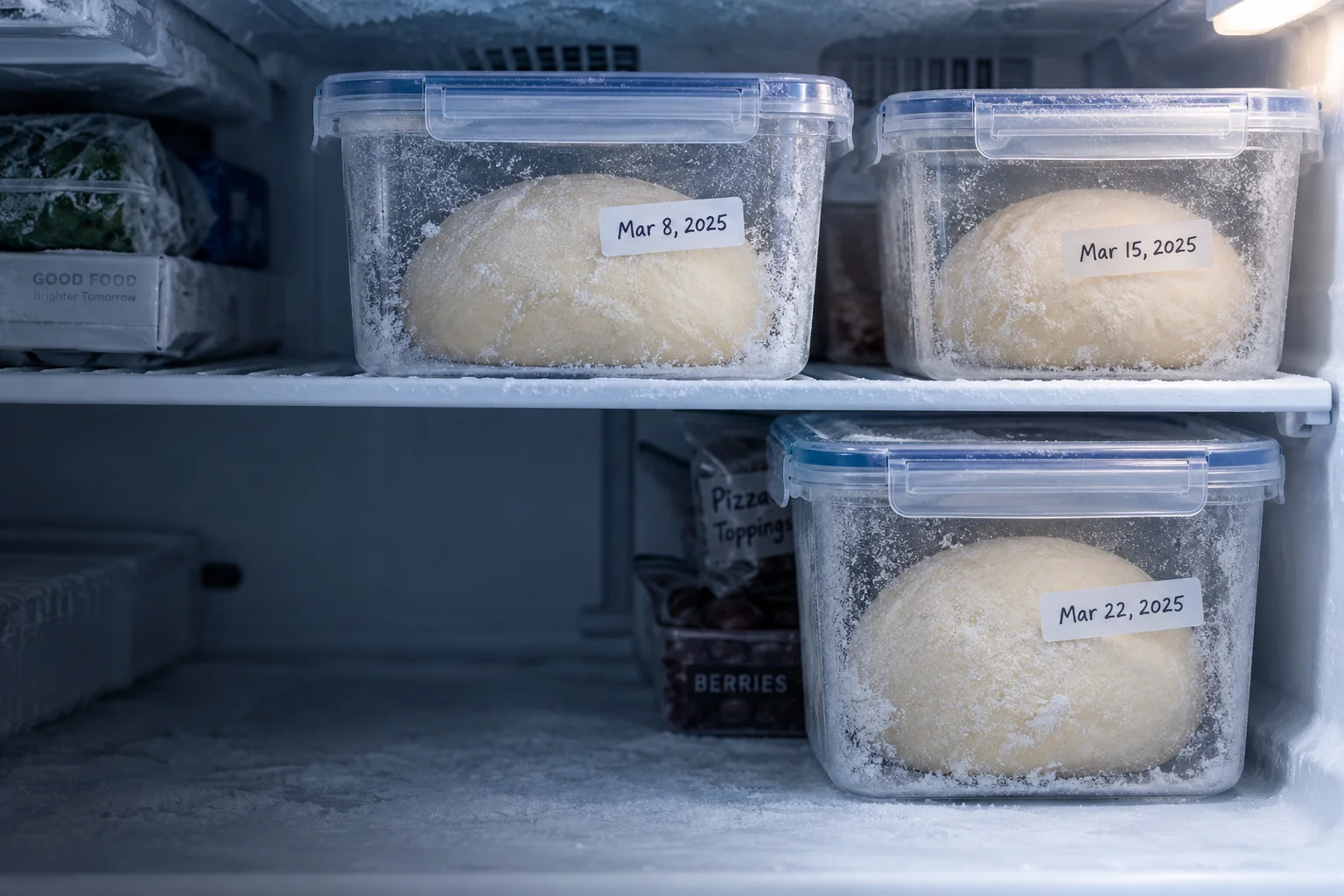
You made too much pizza dough. The fermentation is right, the dough balls look great, and throwing them away makes no sense.
So can you freeze pizza dough?
Yes. But freezing pizza dough is not the same thing as pressing pause on fermentation.
A freezer changes the dough. Yeast cells are exposed to freezing stress, water turns into ice crystals, and the gluten structure can be affected. How you freeze the dough, when you freeze it, and how you thaw it determine whether the dough comes back ready to make pizza or comes back weak, sticky, and difficult to handle.
Here is what is actually happening.
What Happens to Pizza Dough When It Freezes?
Pizza dough contains a surprising amount of water.
At 65% hydration, for example, there are 650 grams of water for every 1,000 grams of flour. Once that dough enters the freezer, some of that water begins forming ice crystals.
That creates two important challenges.
First, ice formation can physically disrupt parts of the dough’s gluten network.
Second, freezing places stress on the yeast cells responsible for fermentation. Some yeast survives very well. Some does not.
That is why thawed dough sometimes feels different even though the formula has not changed.
You may notice less fermentation activity, reduced extensibility, weaker structure, or a dough ball that does not recover quite as aggressively as fresh dough.
None of those automatically mean the dough is unusable. They mean the dough needs to be handled differently.
The Biggest Mistake: Freezing Dough Too Late
If I know dough is going into the freezer, I would rather freeze it while it still has fermentation capacity left than wait until it is completely mature.
Think about what happens otherwise.
You ferment the dough until it reaches its ideal condition. Then you freeze it. Then you thaw it. Then you warm it.
The dough has continued aging through parts of that process, while the yeast and gluten have also gone through freezing stress.
You are asking an already mature dough to survive another major processing step.
A better approach is to treat freezing as part of the production schedule.
Freeze the dough before it reaches the point where you would normally consider it fully ready to bake.
That leaves some room for fermentation during thawing and tempering. Already-mature leftover dough can still be worth freezing, but it may need less recovery time after thawing and gentler handling.
Should Pizza Dough Be Frozen in Bulk or as Dough Balls?
For most home pizza makers and many small foodservice operations, I prefer freezing individual dough balls.
There are several advantages. They freeze faster, thaw more predictably, are easier to portion, and allow you to remove only what you need.
Ball the dough first, lightly coat the surface with oil to prevent drying, and place each ball in a freezer-safe container or properly sealed bag.
Air exposure matters.
Freezer burn is essentially moisture loss from the frozen product. A poorly protected dough ball can develop a dry exterior that becomes difficult to reincorporate later.
Protect the surface and minimize unnecessary headspace. Allow room for expansion when thawing and proofing.
How Quickly Should You Freeze Pizza Dough?
Faster freezing is generally preferable.
Slow freezing encourages the formation of larger ice crystals. Larger crystals have greater potential to disrupt the dough structure.
A commercial frozen-dough operation can use equipment designed for rapid freezing. Your kitchen freezer cannot duplicate that process, but you can still improve your results.
Do not put a large mass of warm dough into an overloaded freezer and expect it to freeze quickly.
Use individual dough balls, give cold air room to circulate around them, and avoid stacking a pile of warm containers together until they have frozen.
Once frozen solid, they can be consolidated for storage.
How Long Can Pizza Dough Stay Frozen?
There is a difference between safe and best quality.
Keep your freezer at 0°F (−18°C) or below. Properly handled food kept continuously frozen at that temperature can remain safe, but dough quality gradually declines. Freezing does not make mishandled dough safe or eliminate the need for baking. See USDA’s freezing and food safety guidance.
For pizza dough, I would approach freezing as a production tool rather than long-term archival storage.
If you regularly make extra dough, date every container. Then use the oldest dough first.
More importantly, test your own formula.
A dough containing a particular yeast level, hydration, flour blend, fermentation schedule, and enrichment may respond differently from another dough.
This is exactly why controlled dough testing matters. Use The Green Light Lab™ Pizza Dough Logbook to compare storage intervals and capture what changed.
The Best Way to Thaw Frozen Pizza Dough
Move the frozen dough into the refrigerator, kept at 40°F (4°C) or below, and allow it to thaw gradually. Depending on dough-ball size and refrigerator temperature, this may take many hours, so moving it the night before you plan to bake is usually much more predictable than trying to rush it. Larger balls may need longer.
Once thawed, the dough still needs time to temper according to your recipe’s proofing schedule.
Cold dough can be tight and resistant to stretching. As its temperature rises, the dough becomes more extensible and fermentation activity increases.
Do not judge the dough five minutes after removing it from the refrigerator. Give it time.
You are looking for a relaxed ball with fermentation activity and enough extensibility to open without constantly shrinking back.
Can You Thaw Pizza Dough on the Counter?
I recommend thawing in the refrigerator first, then giving the thawed dough a controlled tempering or proofing period before baking. Follow your recipe or the manufacturer’s instructions, particularly for dough containing eggs or dairy.
Thawing a frozen ball entirely on the counter makes control more difficult. The outside warms before the center, while yeast activity increases in the warmer portions of the dough. That creates a less uniform process.
A refrigerator thaw followed by controlled tempering gives you a more predictable window for evaluating the dough. Do not leave frozen dough on the counter overnight to thaw.
Temperature is one of the most powerful variables in pizza dough even though it never appears on the ingredient statement.
What If the Thawed Dough Keeps Snapping Back?
Do not immediately blame the freezer.
Dough snap-back is often a temperature and relaxation problem. If the dough is still cold, the gluten network may simply need more time to relax.
This connects directly to another Green Light Lab principle: when dough fights you, forcing it usually makes things worse.
Let it rest. Then try opening it again.
If the dough remains unusually elastic after adequate tempering, you can begin looking at other variables including flour strength, mixing, fermentation, hydration, and dough maturity.
What If the Dough Is Weak and Sticky After Thawing?
That is a different problem.
A thawed dough that spreads excessively, tears easily, or becomes unusually sticky may have been too mature before freezing or may have lost too much structural strength during the combined fermentation, freezing, and thawing process.
This is where recordkeeping becomes valuable. Instead of saying, “Freezing didn’t work,” record:
- When the dough was mixed
- Dough temperature after mixing
- Time before freezing
- Freezer temperature
- Days frozen
- Thawing time
- Tempering time
- Final dough behavior
Now you have an experiment instead of an anecdote.
Change one variable on the next batch. That is the Green Light Lab approach.
Does Frozen Dough Need More Yeast?
Not automatically.
Commercial frozen-dough formulations may be designed specifically around freezing performance, including yeast selection, yeast level, dough conditioners, flour characteristics, processing conditions, and freezing rate.
That does not mean a home pizza maker should simply double the yeast. Increasing yeast changes the entire fermentation system.
Before changing the formula, determine whether the real problem is fermentation timing.
You may get the result you want simply by freezing earlier or giving the thawed dough additional recovery time.
Process before ingredients.
That is a useful rule in product development because formulation changes should solve identified problems, not compensate for uncontrolled processing.
My Preferred Starting Method
For leftover dough that you know you will not use, this is where I would begin:
Freeze individual dough balls before they become fully mature. Protect them carefully from air exposure. Freeze them as quickly as your equipment reasonably allows. Thaw them overnight in the refrigerator, allowing longer if needed. Then follow your recipe’s tempering schedule so the dough can relax and fermentation can become active again.
Most importantly, document the results.
If the first test is not perfect, do not randomly change flour, hydration, yeast, fermentation time, and thawing method simultaneously.
Change one variable. Bake another pizza.
That is how a recipe becomes a repeatable process.
The Green Light Lab Takeaway
Freezing pizza dough works, but the freezer is not a pause button.
Freezing introduces another processing step into a living fermentation system.
Once you understand that, the question changes from:
“Can I freeze pizza dough?”
to:
“At what point in my process should I freeze this dough so it performs the way I want after thawing?”
That second question is much more useful. And it is exactly the kind of question that leads to better pizza.

About the author
Ray Sierengowski
Ray is a food scientist, chef, product developer, author, and founder of Fire in the Kitchen, LLC. He brings more than 30 years of experience in food development, manufacturing, commercialization, and culinary innovation.
© 2026 Ray Sierengowski / Fire In The Kitchen, LLC. All rights reserved. This article may be linked to or quoted with attribution. Reproduction, republication, or commercial use of the article in whole or substantial part requires written permission from Fire In The Kitchen, LLC.
Request permission to republish →Keep testing with purpose
Understand the dough. Record the result.
Pizza Dough by the Numbers explains fermentation, hydration, flour strength, and temperature. Find the companion Green Light Lab™ Pizza Dough Logbook alongside the guide.
Explore product development