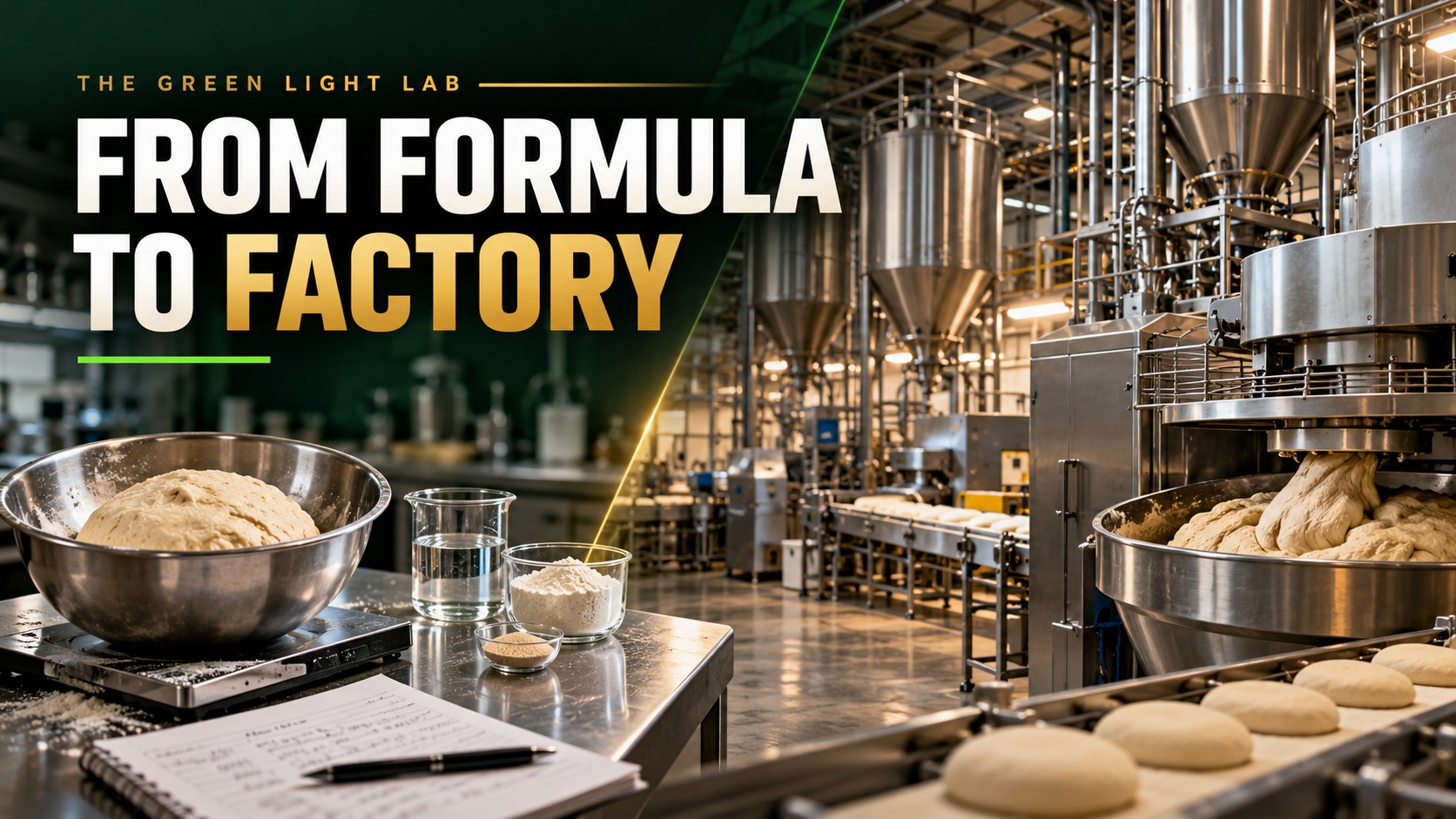
I've spent a good part of my career working with dough, mixing equipment, and food manufacturing systems, and one thing I've learned is that a great formula doesn't always translate into a great production process.
You can develop a dough in the lab that performs exactly the way you want. Good hydration, proper development, consistent handling. Then you take that same formula into a production environment and suddenly you're dealing with temperature differences, longer mixing cycles, ingredient variability, and a product that doesn't behave quite the same.
So what changed? Sometimes nothing in the formula changed at all. It's the process that changed.
That's where food science and manufacturing engineering really need to work together. And this isn't unique to dough. Bread, snack cakes, cookies, bars and other formulated foods can all surprise you when you move from a lab to a commercial line. The challenge isn't simply making more product. It's producing the quality you intended, over and over, at a cost the business can support.
Scaling a Formula Is Not Simple Math
Let's say you develop a dough using a 20-kilogram batch in a small mixer. Everything looks right: good incorporation, the dough develops on schedule, and your target temperature is easy to hit. Now you move to a system handling hundreds or thousands of kilograms. You can multiply the ingredient weights, but you cannot assume the mixing conditions will multiply along with them.
Equipment geometry, batch loading, ingredient addition, rotational speed and heat transfer all affect how the product develops. Your mixing time might be longer or shorter, yet the dough may still receive a very different amount of mechanical work. Ingredient incorporation can also become less uniform if the process wasn't designed for the larger volume.
That is why I like to separate the formula from the process. The formula tells us what goes into the product. The process tells us what we do to those ingredients to create the structure and performance we want.
Hydration: Same Percentage, Different Behavior
Hydration is a good place to see the problem. Take a dough running at 65% hydration on a flour-weight basis. At 1,000 kilograms of flour, you're adding 650 kilograms of water. Move hydration by just one percentage point and you've changed the added water by 10 kilograms.
In a bakery, that can be enough to affect dough consistency, handling, machinability and finished texture. But there's another part of the equation: how the water gets into the flour. Was it introduced evenly? How quickly did the flour wet out? Did dry pockets remain during the early part of mixing? Was the dough allowed enough time to develop?
Two lines can follow the same percentages and still end up with different products because water distribution and mixing history aren't identical. Accurate dosing matters, but it doesn't replace effective incorporation and controlled hydration.
Mixing Energy Matters More Than the Stopwatch
I've heard plenty of conversations that start with a target mixing time. That's useful information, but it isn't the whole story. Seven minutes in one mixer may not be equivalent to seven minutes in another. The equipment design, speed, loading and dough consistency all influence the mechanical work delivered to the product.
Mechanical work also creates heat. Depending on the formulation and process, that temperature rise can change gluten development, dough handling and subsequent fermentation. If you only watch the clock, you may miss what the mixer is actually doing.
I want to know what the dough looks and feels like at discharge, what temperature it reached, and whether it behaves the way we need it to on the next machine. Consistent product development is the goal, not an arbitrary number of minutes.
Sometimes the Problem Starts Before the Mixer
When a production team sees an inconsistent finished product, the mixer is an obvious place to look. Sometimes the issue starts upstream. Flour condition, storage, pneumatic conveying, ingredient segregation, microingredient accuracy and addition sequence can all influence what happens in the bowl.
Incoming flour lots may satisfy the same general purchasing specification and still differ in absorption or dough strength. Powders can vary in particle size and flow characteristics. An ingredient that's difficult to meter accurately won't suddenly become consistent because the mixer is performing well.
This is why I don't view ingredient handling as a separate utility. It's part of the process that determines finished-product quality. The operation starts when the raw material arrives, not when the mixer turns on.
The Cost of Inconsistency Adds Up
Now let's talk about the business side, because this is where the engineering and food science decisions become particularly important.
A line may have the nameplate capacity to produce the required volume and still struggle financially if operators are constantly making adjustments, throwing away off-spec product, dealing with unplanned downtime or slowing the line to protect quality. You can buy more capacity without buying more usable output.
When evaluating a new system, I would look beyond the equipment price and rated throughput. What's the first-pass yield? How much scrap or rework is typical? What does a product changeover involve? How much cleaning and operator intervention does the process need? How reliably can it run with normal ingredient variation?
For many manufacturers, improving repeatability can deliver real value even without running the machine any faster. Less waste and more predictable production make a measurable difference to operating cost.
What I Would Validate Before Going to Full Production
There isn't one universal scale-up checklist, but I'd want answers to a few basic questions before committing to a full-scale process:
- Raw materials. Are we measuring the properties that determine how the ingredients perform, not just what appears on a certificate of analysis?
- Critical process conditions. Do we know the acceptable ranges for dosing, ingredient addition, temperature, mixing energy and residence time?
- Finished-product behavior. Does the product handle correctly through forming, proofing, baking, cooling or packaging, as applicable?
- Plant performance. Are we evaluating yield, downtime, rework, energy use and throughput under realistic conditions?
- Operating flexibility. Can the system accommodate the normal changes in ingredients and production demand without constant troubleshooting?
Pilot runs and plant trials are where these questions become real. The most productive trials include R&D, engineering, operations, quality and the equipment supplier, because each group sees a different part of the same process.
Build the Process Around the Product
Food manufacturing doesn't need another piece of equipment chosen only because it looks impressive on a specification sheet. It needs systems designed around what the finished product must do.
What texture are we after? How should the product handle? What ingredient variation is realistic? What will the line need to produce next year, not just this month? And what level of quality can the business sustain at the required operating cost?
Those are the questions I believe should come before the equipment specification. Start with the product and its functional requirements, then work backward into the process and machinery.
You don't really prove a formula when it works once in the lab. You prove it when the manufacturing system can make it consistently, with the right quality and economics, day after day.
About The Author
Ray Sierengowski is a food scientist, chef, author, and food-industry consultant with more than 30 years of experience in food product development, industrial dough processing, technical sales, and food manufacturing systems. His Green Light Lab articles explore the science behind better food and the decisions that make production more consistent.
Sources & Further Reading
Institute of Food Technologists, "Formulating for New Product Scale-Up," March 19, 2026. IFT: Formulating for New Product Scale-Up
© 2026 Ray Sierengowski | Fire In The Kitchen, LLC. All rights reserved.