
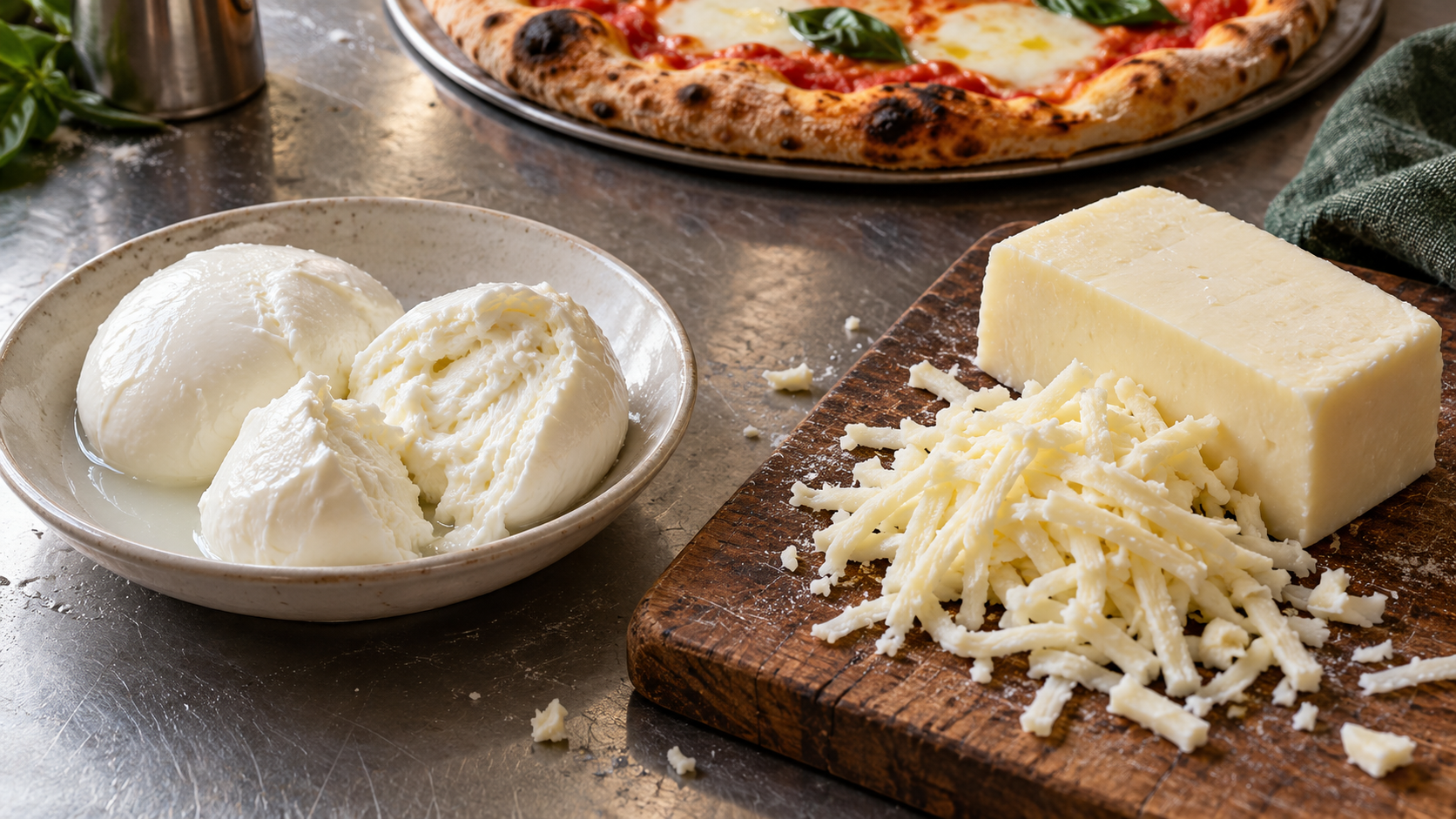
You buy a beautiful ball of fresh mozzarella, put it on your usual pizza, and expect an upgrade.
Then you cut the first slice. The cheese tastes good, but the pizza is different from what you intended. The coverage has changed. So has the balance between cheese, sauce, and crust.
Was the cheese wrong? Or did you ask a different ingredient to do the same job without changing the instructions?
Fresh mozzarella and low-moisture mozzarella can both make excellent pizza. Choose between them by the finished pizza you want, not by which name sounds more premium.
At Underground Pizza Truck, my $15, 12-inch cheese or pepperoni pizza has to justify its value through the complete experience. Premium ingredients matter to me. So does knowing what I expect each ingredient to contribute.
Start with the pizza, then choose the cheese
Before comparing brands, describe the result you want.
Do you want separate patches of milky cheese with sauce visible between them? A connected layer across the slice? A particular bite once the pizza has cooled enough to eat? A cheese flavor that supports the sauce or one that leads the whole pizza?
Those are useful buying instructions. “Get the best mozzarella” is not specific enough.
Grande, Bacio, BelGioioso, and Galbani all deserve consideration in this discussion. The useful comparison is what a specific product offers your pizza, rather than which brand makes the strongest promise.
Fresh versus low-moisture is one decision; milk fat is another
Fresh mozzarella generally carries more moisture and a soft texture. Low-moisture mozzarella has more water removed during manufacture. Arla's September 7, 2026 application guidance makes the useful point that neither format suits every pizza. [2]
“Whole milk” and “part skim” describe a different aspect of the cheese. Do not treat fresh, low-moisture, whole milk, and part skim as four mutually exclusive categories.
The U.S. Dairy Export Council describes low-moisture part-skim mozzarella as firm and well suited to shredding, and whole-milk mozzarella as offering a creamy character and even melt. Those descriptions help narrow candidates; they do not select a winner for your oven. [3]
| Decision | What to ask for |
|---|---|
| Fresh or low-moisture | Exact product identity, format, preparation instructions, and intended application |
| Whole milk or part skim | The specific formulation and the eating qualities you need |
| Block, shred, dice, or log | Portion method, preparation work, storage instructions, and usable yield |
| Single cheese or blend | A defined flavor and appearance target, plus a repeatable blend ratio |
Four brands worth comparing, and what the numbers tell us
Grande belongs in any serious discussion of pizza cheese. So do other manufacturers offering different formulations, formats, and operator support. These four are a comparison shortlist, not a market-share ranking or the results of a Green Light Lab taste test.
I did not find a representative, independent survey showing which of these brands most U.S. pizza operators prefer. What we can compare are documented product details and clearly attributed operator reports. The reasons to consider each brand below are practical interpretations of those details, not measured reasons for purchase across the industry.
| Brand | Published facts and numbers | Why an operator might consider it |
|---|---|---|
| Grande | East Coast Blend combines 50% low-moisture whole-milk mozzarella and 50% low-moisture part-skim mozzarella. Its diced product, item 00716, lists milk, cheese culture, salt, and enzymes, with no preservatives, fillers, or artificial ingredients. [6] | A defined whole-milk/part-skim balance in a ready-prepared format can help an operator repeat a blend without dicing and mixing it in-house. Evaluate the flavor, coverage, and eating texture on your pizza. |
| Bacio | The company uses cow's milk plus buffalo milk but does not disclose the buffalo-milk percentage. Its Gold Club advertises $0.06–$0.18 per pound in rewards, depending on purchasing tier and program terms. [7] | Its milk blend is a reason to include it in a flavor comparison. Distributor access and purchasing support may also matter commercially. A reward reduces eligible purchasing cost; it does not establish superior cheese performance. |
| BelGioioso | Its pizza-formula fresh mozzarella, item 00901, comes in six 2-pound logs per case. The manufacturer describes it as a lower-moisture fresh formulation developed for pizza, but the page does not publish a moisture percentage. [4] | Worth evaluating when the target is a fresh-mozzarella character in a pizza-oriented format. The log offers a practical portioning format, but actual preparation, yield, and bake behavior still need checking. |
| Galbani | Lactalis lists fresh mozzarella and premium low-moisture products, including a 50/50 whole-milk low-moisture mozzarella/provolone shredded blend. This is a different blend from Grande's 50/50 whole-milk/part-skim mozzarella. [8] | Its range allows an operator to compare formats and flavor options within one brand. The mozzarella/provolone option is relevant when the goal is a different cheese flavor, rather than simply switching mozzarella suppliers. |
A reported result is useful, but it is not an industry ranking
Bacio's August 2026 announcement describes the 19-location Tommy's Tavern and Tap operation and reports pizza complaints falling from approximately 1.5% to 0.25% after switching to its cheese. That is a 1.25-percentage-point decline. It is a supplier-published customer account, not a controlled comparison against Grande, BelGioioso, or Galbani. The release does not establish that cheese alone caused the improvement. [1]
Those are different kinds of numbers: formulation ratios, pack sizes, rewards, and a customer case report. None measures the percentage of operators who prefer a brand. I would use them to ask better buying questions, then let the pizza decide.
My position is simple: include Grande in the conversation, give every candidate the same evaluation, and buy the product that meets your specification. A brand can be an excellent choice without being the right choice for every pizza.
What does “melts well” actually mean?
I would separate that phrase into things you can describe: coverage, visible shreds after baking, browning pattern, surface oil, stretch, and texture when eaten.
One dramatic cheese pull does not answer all those questions.
Research published in the Journal of Food Science examined differences in cheese browning and blistering and their relationship to functional properties. Its findings reinforce why appearance cannot be predicted from a cheese name alone. [5]
For your own pizza, decide what acceptable looks and tastes like before testing. A lightly colored cheese surface may suit one menu item; a more browned finish may suit another. A photograph of your target pizza is a useful part of the specification, but taste and texture still need their own notes.
A practical cheese comparison has two stages
Stage one: can it replace what you use now?
Use your established pizza as the reference. Select one candidate and write down the exact product, lot or date code, and preparation method.
Follow the manufacturer's handling directions. Weigh cheese after any prescribed draining or preparation, and record that stage consistently. Use the same dough specification, diameter, sauce weight, and topping arrangement. Record baking conditions and the order of the pizzas.
Start with equal ready-to-use cheese weights to ask a narrow question: what happens if I substitute this product at my current portion?
That comparison does not isolate moisture scientifically. Different cheeses can differ in several properties at once. It evaluates a practical substitution.
Stage two: can it make the pizza you want?
Now allow a deliberate adjustment. A different cut size, distribution, or portion may be worth testing. Change one of those settings at a time and document it.
This stage answers a different question: what recipe makes this candidate useful?
Keep the results separate. If one pizza uses a different cheese and a different portion, do not describe it as proof that cheese type alone caused the result.
Use simple sample codes instead of brand names when tasting. Ask people to describe the difference before asking which they prefer. Repeat the comparison rather than making a purchasing decision from a single pie.
Compare cost per pizza, not just cost per pound
Here is a hypothetical calculation, not supplier pricing or a recommended cheese portion:
| Candidate | Price per kilogram | Ready-to-use portion | Cheese cost per pizza |
|---|---|---|---|
| A | $8.00 | 100 g | $0.80 |
| B | $10.00 | 80 g | $0.80 |
The ingredient cost is equal in this example. The pizzas are not necessarily equal in flavor, coverage, or value.
Only use the smaller portion if it delivers the intended product. Also include preparation labor, trimming or draining losses where applicable, and waste. If a purchase price includes material you do not use on the pizza, calculate usable cost before applying this table.
For a small operator paying commissary costs and managing limited time, the correct choice has to work beyond the sample table. A cheaper case is not automatically a lower-cost pizza, and a more expensive case is not automatically a better one.
Write down the cheese decision
When you approve a product, record the supplier item code, portion weight, cut or shred format, preparation steps, and a photo of the intended coverage. Include manufacturer storage instructions and an approved substitution procedure.
“Mozzarella” on a purchasing sheet leaves too much unanswered.
If the distributor cannot supply your usual item, use the specification to assess the replacement. Do not wait until service to discover that the substitute needs a different portion or preparation method.
The Green Light Lab takeaway
Myth: Fresh mozzarella is always the upgrade.
Better question: Which mozzarella gives this pizza the flavor, appearance, handling, and cost I need?
Define the result. Compare specific products. Record the conditions. Then make the decision.
That is the same disciplined approach behind Pizza Dough by the Numbers and The Green Light Lab Pizza Dough Logbook. The variables extend beyond dough. If you are developing a pizza program or revising an ingredient specification, Fire In The Kitchen can help connect the recipe to the operation that has to produce it.
© 2026 Ray Sierengowski / Fire In The Kitchen, LLC. All rights reserved. For republication permission, contact ray@fireinthekitchen.com.
Sources
- Bacio: Bar-and-Grill Operators Invest in Premium Cheese. Announcement dated August 18, posted August 19, 2026. Manufacturer marketing, used as industry context only.
- Arla Pro: Fresh Mozzarella vs Low-Moisture Mozzarella. September 7, 2026. Manufacturer application guidance.
- U.S. Dairy Export Council: Cheese for Pizza & Blends. Industry technical reference, checked November 2, 2026.
- BelGioioso: Unsliced Pizza 2 Lb Log. Current manufacturer description, checked November 2, 2026. No independent performance endorsement implied.
- Ma et al., Quantification of Pizza Baking Properties of Different Cheeses, and Their Correlation with Cheese Functionality. Journal of Food Science, 2014. Abstract supports the narrow functional-properties statement above; no new experiment is claimed.
- Grande: East Coast Blend Dice, item 00716. Manufacturer specification updated April 1, 2025; checked November 2, 2026. Details apply to this product, not automatically every Grande cheese.
- Bacio: Frequently Asked Questions. Milk-blend disclosure, distribution, and Gold Club reward rates checked November 2, 2026. Confirm current eligibility and terms before calculating net cost.
- Lactalis Culinary: Galbani product portfolio. Fresh, premium low-moisture, and mozzarella/provolone blend listings checked November 2, 2026.