The pizza business has never suffered from a shortage of creativity. Walk into almost any pizzeria today and you’ll find something that would have raised a few eyebrows twenty years ago. Hot honey, specialty proteins, Detroit-style crusts, creative limited-time offerings, and combinations that sometimes make you wonder who came up with them in the first place.
Some are brilliant. Others probably should have stayed in the test kitchen.
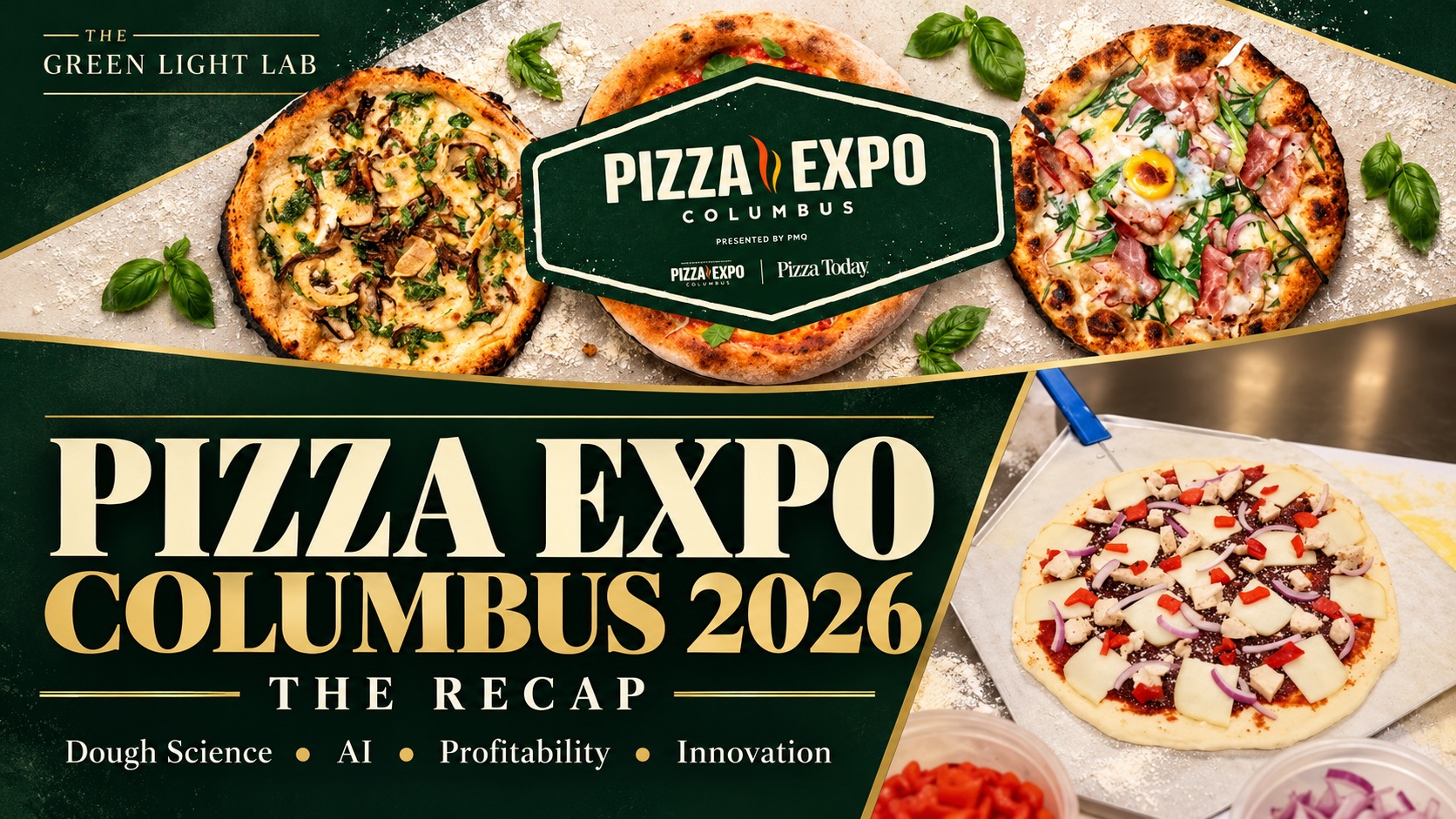
But looking through the coverage from Pizza Expo Columbus 2026, held October 11–12 at the Greater Columbus Convention Center, something else caught my attention.
Beyond the competitions, equipment, and latest topping trends, there was a noticeable emphasis on fundamentals, operational discipline, technology, and the financial realities of running a pizza business.
As someone who has spent more than 30 years working in food science, product development, manufacturing, and the commercial side of the food industry, I find that encouraging.
Because the next meaningful competitive advantage in pizza may have less to do with what goes on top of the crust and considerably more to do with how well operators understand everything underneath it.
Dough Science Is Finally Getting the Attention It Deserves
One of the educational highlights in Columbus was a demonstration on proper mixing techniques led by Frank Zabski. The session addressed the consequences of undermixing and overmixing dough, and how those conditions affect product consistency and performance.
Other demonstrations explored Detroit-style pizza and contemporary Italian techniques, including Neapolitan and Classica styles.
To me, this is one of the most encouraging developments coming out of the event.
For years, the pizza industry has relied heavily on tradition, experience, and recipes passed from one generation to another. There is tremendous value in that knowledge. I certainly wouldn’t dismiss it.
But there’s also tremendous value in understanding why those recipes work.
Why does a particular flour perform differently at 65% hydration than it does at 68%? Why does the same formula behave differently when the finished dough temperature changes by five degrees? Why does one batch bake beautifully while another, made with supposedly identical ingredients, produces an entirely different crust?
Those aren’t mysteries. They’re questions that can be answered through food science and controlled experimentation.
It’s a big part of why I wrote The Food Scientist’s Guide to Better Pizza Dough. I wanted operators and home pizza makers to understand that you don’t need a laboratory or an advanced degree to start thinking like a scientist.
You need to understand your ingredients, measure your variables, and pay attention to the results.
I believe operators who embrace that approach will have a measurable advantage over the next year or two.
Not because science replaces craftsmanship, but because it makes craftsmanship more repeatable.
The best pizza in the world doesn’t do much for your business if you can only make it consistently three days out of seven.
Artificial Intelligence Has a Place in the Pizzeria, and It’s Bigger Than You Think
Another notable topic at Columbus was artificial intelligence.
Mike Bausch of Andolini’s Pizzeria presented a session titled AI Office, Analog Kitchen, exploring how operators can incorporate emerging technology into their businesses while maintaining traditional kitchen procedures.
It’s an interesting concept, and one I largely agree with.
But I also think the applications go well beyond office administration, marketing, and answering telephone orders.
I use AI in my own pizza development work.
I’ll photograph dough during different stages of development, examine finished crust characteristics, look at topping distribution, and compare results between batches.
AI gives me another perspective on what I’m seeing. It can help identify visible inconsistencies, suggest possible explanations, and challenge me to look at variables I might otherwise overlook.
It’s almost like having an additional feedback panel available whenever I need one, often at little to no incremental cost.
Now, I want to be clear about something. AI cannot measure gluten development, accurately determine water activity, or tell you exactly how a crust tastes simply by looking at a photograph.
And it certainly doesn’t replace actual testing, sensory evaluation, or professional judgment.
But it can be a remarkably useful tool for evaluating visible differences, organizing observations, developing hypotheses, and deciding what to test next.
I see AI as another tool in the food scientist’s toolbox.
And like most technology, the economics will eventually determine adoption. As the price of these tools comes down and their capabilities improve, more independent operators will find practical ways to incorporate them into daily operations.
We saw this evolution with computerized ordering, POS systems, and automated production equipment.
AI will follow a similar path, although not every application will justify its cost.
My advice is straightforward: use the technology where it helps you make a better decision, save time, or improve consistency.
Ignoring a useful source of feedback simply because it’s unfamiliar doesn’t make much business sense.
The Most Overlooked Cost in Pizza Isn’t Cheese, Flour, or Labor. It’s Your Time.
The Columbus education program devoted significant attention to profitability.
Nick Bogacz of Caliente Pizza & Draft House presented on combating rising food costs. Other sessions addressed financial literacy, analyzing costs for growth, waste reduction, and sustainable operating practices.
These are important conversations, particularly for independent operators dealing with rising ingredient prices and labor expenses.
But there’s one cost I think we consistently overlook.
Our own time.
I see this frequently among people who are passionate about what they do. They spend hours developing recipes, preparing ingredients, managing inventory, cleaning equipment, placing orders, answering customers, and keeping the business running.
And because they love it, they often don’t account for those hours the same way they would an employee’s time.
Think about that for a moment.
If you’re spending fifteen hours a week preparing dough, developing recipes, maintaining equipment, and managing purchasing, what is that time actually worth?
What would you have to pay someone else to perform those responsibilities?
Many small business owners calculate food cost, packaging, utilities, rent, and payroll, then look at what’s left and call it profit.
But if the owner is working sixty hours a week without accounting for a reasonable wage, the numbers can create a misleading picture of profitability.
There’s a difference between owning a profitable business and owning a job that happens to pay you whatever money is left over.
I’ve been guilty of getting so involved in the technical and creative side of a project that I lose track of how much time I’ve invested.
That’s part of being passionate about your craft.
But passion doesn’t eliminate opportunity cost.
As operators, we need to put a value on our own time, just as we would any other resource in the business.
Otherwise, we may be optimizing food cost down to the penny while overlooking one of our largest expenses.
Innovation Is Driving Pizza Forward, but Are We Losing Sight of the Fundamentals?
The Great American Pizza Challenge brought regional styles into the spotlight, with competitions recognizing Columbus, New Haven, New York thin, tavern, St. Louis, and other styles.
Anthony Berghela of Romo’s Pizza took the overall traditional thin-crust title with a New Haven-style entry. Davide Lubrano Lavadera of Dough Bros. won the overall non-traditional thin-crust division. Wilhelm Rodriguez of Papa’s Pizza earned the title of America’s Best Pepperoni Slice.
The range of styles and competition categories highlights just how diverse the pizza industry has become.
And I think that’s a good thing.
Consider Detroit-style pizza. The caramelized cheese crust, often referred to as frico, is a fantastic example of food chemistry and baking technique coming together to create something distinctive.
Or Chicago tavern-style pizza, where a thin, crisp crust produces an entirely different eating experience from a traditional New York slice.
These aren’t simply different shapes of pizza. They involve different approaches to formulation, dough handling, baking, and finished-product characteristics.
That diversity creates opportunities for operators to distinguish themselves.
Specialty pizzas also provide opportunities for premium pricing. A thoughtfully developed hot honey and soppressata pizza may command a higher selling price than a traditional pepperoni, assuming the market supports it and the additional ingredient costs are controlled.
Limited-time offerings can create excitement, encourage trial, and give customers reasons to return.
But there’s another side to all this innovation.
Sometimes we get so caught up in what we’re putting on top of the pizza that we forget about the pizza underneath it.
A poorly fermented crust doesn’t suddenly become exceptional because somebody covered it with expensive cheese, hot honey, and three different proteins.
A bland sauce doesn’t improve because the toppings are trending on social media.
And adding six different regional styles to a menu doesn’t necessarily make an operation more competitive if the kitchen can’t execute them consistently.
Every new ingredient, process, and pizza style introduces additional variables.
More inventory. More training. More preparation. More opportunities for waste. More potential inconsistency during a busy service.
There’s nothing wrong with creativity. I encourage it.
But innovation needs to earn its place in the kitchen.
At its simplest, pizza is a remarkable combination of dough, sauce, and cheese. Each component matters, and the balance between them determines whether the finished product works.
My view is that the most successful operators aren’t choosing between tradition and innovation. They’re mastering the fundamentals first and innovating from there.
A great Detroit-style pizza still needs great dough.
A hot honey pizza still needs proper balance.
And an award-winning specialty pizza should be able to stand on the quality of its underlying crust, not just the novelty of its ingredients.
Gluten-Free Pizza Is Another Example of Why Technical Understanding Matters
One other competition result worth recognizing was Anthony Gilbert of Melt Pizza Co. in Stillwater, Minnesota, winning America’s Best Gluten-Free.
Gluten-free pizza continues to present some fascinating technical challenges.
Remove gluten from a conventional wheat-based dough system and you’ve removed the protein network responsible for much of its elasticity, extensibility, and gas retention.
Now you’re relying on alternative starches, hydrocolloids, proteins, and process adjustments to create the structure and eating quality consumers expect.
You aren’t simply swapping one flour for another.
You’re designing a different food system.
That’s why I enjoy seeing categories like this receive serious recognition. They demonstrate how technical innovation and culinary craftsmanship can work together to solve real formulation challenges.
Fifty Years in Pizza Might Be the Most Important Lesson of All
The Columbus event also featured a keynote from the Ulrey brothers of Flyers Pizza & Subs, a Columbus-based company celebrating 50 years in business.
Scott, Steve, Mark, and Dave Ulrey discussed how their family business grew into a ten-location operation while maintaining its independence.
Their story included major operational changes over the years, investments in technology, relationships with employees and the community, and the decision to establish an employee stock ownership plan in 2016.
To me, there’s something particularly relevant about this story appearing alongside discussions of AI, automation, and evolving pizza styles.
Technology changes. Customer preferences change. Equipment improves. Costs fluctuate.
But running a successful food business still requires consistency, good decisions, disciplined operations, and people who care about the product.
Fifty years of business longevity is an achievement worth recognizing.
It also reminds us that innovation isn’t a new concept. Successful operators have always adapted.
The difference today is the speed at which new technologies and ideas become available.
That makes it even more important to understand which changes actually improve your business and which ones simply create additional work.
Where Do We Go From Here?
If there’s one conclusion I draw from Pizza Expo Columbus 2026, it’s that the industry has an opportunity to become more technically disciplined without losing the creativity and personality that make pizza special.
We should absolutely experiment with new ingredients, styles, equipment, and technologies.
We should embrace artificial intelligence where it gives us useful information.
We should continue challenging traditional processes when there may be better ways to produce consistent results.
And we should pay closer attention to the economics of what we’re doing, including the value of our own time.
But none of those advances eliminate the need to understand the product.
A great pizza still depends on proper ingredient selection, dough development, fermentation, baking, and balance.
The more we understand those variables, the more control we have over the outcome.
For me, that’s the most encouraging message coming out of Columbus.
We’re seeing more opportunities for operators to combine craftsmanship with science, technology, and sound business practices.
Not every new idea will be worth adopting, and not every traditional method needs to be changed.
The challenge is knowing the difference.
The next competitive advantage in pizza may not be another topping, another oven, or another marketing trend.
It may simply be understanding your product and your business better than the operator down the street.
And that’s a direction I can get behind.
About the Author
Ray Sierengowski is a food scientist, chef, and food industry professional with more than 30 years of experience in product development, manufacturing, and commercial leadership. He is the author of The Food Scientist’s Guide to Better Pizza Dough and writes The Green Light Lab at Fire In The Kitchen.