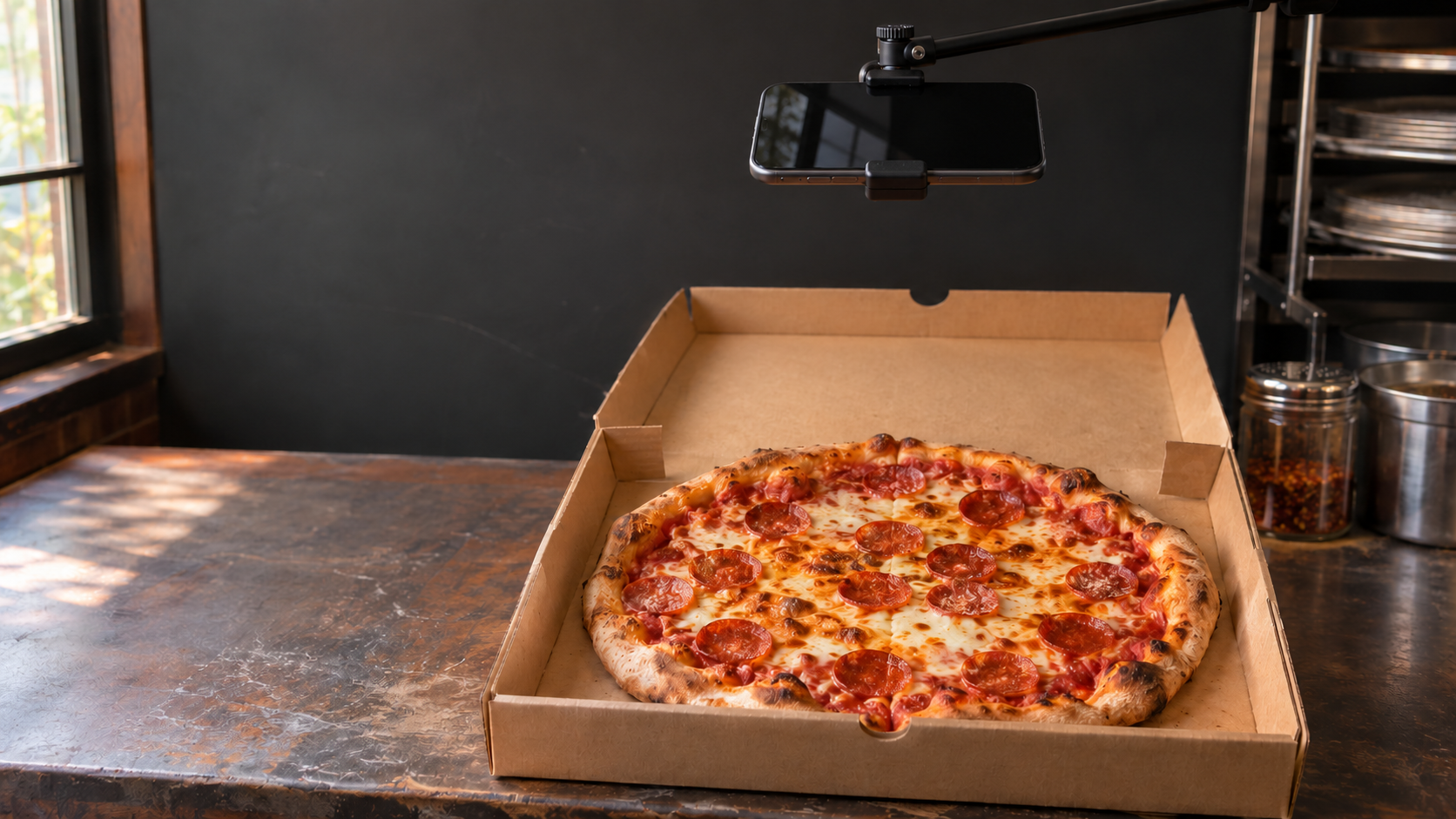
A pizza can look excellent in a photograph and still disappoint when you take a bite.
The cheese may be evenly distributed. The rim may have the color you expected. Every slice may look ready for a menu photo.
But was the center baked the way you intended? Did the crust stay crisp? Was the sauce balanced? Did the customer receive it promptly?
A picture answers some quality questions. It leaves others open.
That distinction matters as pizza companies put more cameras and artificial intelligence into their quality programs. Independent operators can learn from the idea without assuming they need the same technology.
Why pizza photos are in the news
Papa Johns announced its customer-photo and feedback promotion on November 9, 2026. The company asks participating customers for an unedited pizza image and their assessment of the order. [1]
On November 16, Reuters reported that the company is using customer images in an AI-based quality-control effort. That report describes visual checks and the limitations of less-controlled customer photographs. [2]
These are company initiatives and reported plans, not independent proof of improved pizza quality. The useful question for an operator is what information would help make the next pizza better.
Start by defining the pizza you intend to make
Before a person or a camera can identify an unacceptable pizza, someone must define acceptable.
A pale rim is not necessarily a defect. Dark spotting is not automatically a failure. Different styles, recipes and baking methods produce different appearances.
For your own operation, identify a few visible characteristics that support your product:
- Shape and usable size.
- Topping coverage.
- Rim appearance.
- Obvious damage or missing ingredients.
- Cut completeness and serving arrangement.
Use examples from your actual production. Include acceptable variation, not just the most attractive pizza you have ever made.
The standard should help a trained person make a decision during service. If every pizza requires a debate, the standard needs work.
What a photograph can help you check
A reasonably consistent image can document whether toppings are concentrated on one side, whether a section appears unusually dark, or whether a pizza arrived visibly damaged.
It can also create a record that is easier to discuss than “the pizza looked wrong.”
For internal checks, keep the camera position, lighting and distance reasonably consistent. Record the pizza style and the stage at which the image was taken.
A photograph at the oven exit and a customer photograph twenty minutes later document different moments. Neither is wrong, but they should not be treated as interchangeable.
The aim is comparable observations, not attractive social content.
What the photograph leaves out
An overhead image does not directly measure temperature, flavor, aroma, tenderness or crispness. It does not show the underside unless someone photographs that too.
Even an image that suggests a problem does not establish its cause.
A darker area might justify checking the bake, but the picture alone cannot tell you whether oven conditions, product placement, formulation or another variable produced it.
A compressed or warm-toned image can also change your impression of color. That is one reason customer photos should be interpreted alongside their comments and the order context.
Treat the image as one observation. Pair it with information that addresses the question you are investigating.
Separate three kinds of quality checks
Appearance
Does the pizza resemble the product you intended to serve? Use defined visual criteria and real examples.
Process
Was it made through the intended procedure? Relevant records might include dough identification, portion specifications, bake settings and preparation timing.
A process record is not proof that a customer liked the pizza. It helps investigate a result.
Eating experience
What did the person actually experience? Ask about the crust, flavor balance, texture and condition when eaten.
A customer does not need to identify a manufacturing cause to give useful feedback. “The middle felt wet when I picked up the slice” is more actionable than asking the customer to diagnose fermentation.
Good quality control connects these three perspectives instead of expecting one to replace the others.
A small-pizzeria test you can run without AI
Here is a proposed learning exercise, not a completed Green Light Lab study.
Choose one pizza style and write a short visual standard. Then sample pizzas across more than one service period.
For each sampled pizza:
- Photograph it at a defined stage using the same setup.
- Record a simple pass, review or remake decision for each visible criterion.
- For selected internal test pizzas, inspect the underside and a cut section.
- Taste at a consistent elapsed time and describe the result in plain language.
- Record enough process context to investigate a repeated problem.
Do not attach a claim of statistical reliability to a small convenience sample. Its purpose is to expose questions and improve the checking method.
Have two people assess a few of the same images independently. If they frequently disagree, review the definitions and examples before blaming the people.
If the photographs pass but the eating assessment fails, that is valuable information. Your visual check is missing something that matters.
Ask customers questions they can answer
“Was everything good?” is friendly, but it may not give you much to work with.
Try specific, neutral prompts:
- How long after receiving the pizza did you eat it?
- What did you notice about the crust?
- Was any part of the pizza different from what you expected?
- Would you order the same pizza again, and why?
Give customers room to describe what they liked as well as what disappointed them. Avoid leading them toward praise or a diagnosis.
If feedback is rewarded, do not condition the reward on a positive opinion. Keep private improvement feedback separate from a public endorsement request.
Not every customer will respond. Feedback from volunteers is useful, but it is not automatically representative of every customer.
Turn observations into a decision
Suppose several internal checks show topping coverage concentrated near the center. That gives you a specific assembly issue to investigate.
Suppose instead the top looks consistent but customers repeatedly describe a disappointing base. Check the relevant product and process conditions rather than spending more time improving the photograph.
For every repeated observation, write down:
- What was observed.
- What you think might explain it.
- What you will change or measure next.
- How you will judge whether the change helped.
The proposed explanation is a hypothesis, not a finding. Keep that distinction visible in your notes.
This is also where cheese selection and packaging performance connect to quality. The appearance at one moment does not describe the entire eating experience.
What this means for an independent operator
At Underground Pizza Truck, my stated offer is a $15, 12-inch cheese or pepperoni pizza built around premium ingredients, handmade dough with a 72-hour fermentation, and the experience of buying from a small business.
That promise has to survive ordinary production, not just the pizza selected for a photograph.
A small operation does not need to copy a national chain's technology budget. It needs a clear product standard, a practical way to observe variation, and a habit of acting on useful information.
Start with a phone, a short checklist, honest tasting and a record of what changed. Consider more technology when you can explain which problem it will solve and how you will evaluate it.
The Green Light Lab takeaway
Myth: If a pizza passes a photo check, it passes the quality check.
Fact: Appearance is one part of quality. A stronger assessment combines the image, the process and the eating experience.
A good photograph can start an investigation. It should not end one.
Explore Pizza Dough by the Numbers and The Green Light Lab Pizza Dough Logbook for the same discipline applied to dough: record the variables, assess the result and make a deliberate next adjustment.
For help defining product standards or connecting a recipe to repeatable production, contact Fire In The Kitchen.
© 2026 Ray Sierengowski / Fire In The Kitchen, LLC. All rights reserved. For republication permission, contact ray@fireinthekitchen.com.
Sources
- Papa Johns, November 9, 2026: customer-photo campaign announcement. Primary source for the campaign, not evidence of its effectiveness.
- Reuters, November 16, 2026: Papa John's turns to AI to check pizzas from customers' photos. Reported company activity, not independent validation of an inspection system.
The proposed checklist and trial are editorial recommendations, not a published experiment or a description of Ray's completed testing. No model-accuracy percentage or measured improvement is claimed.