
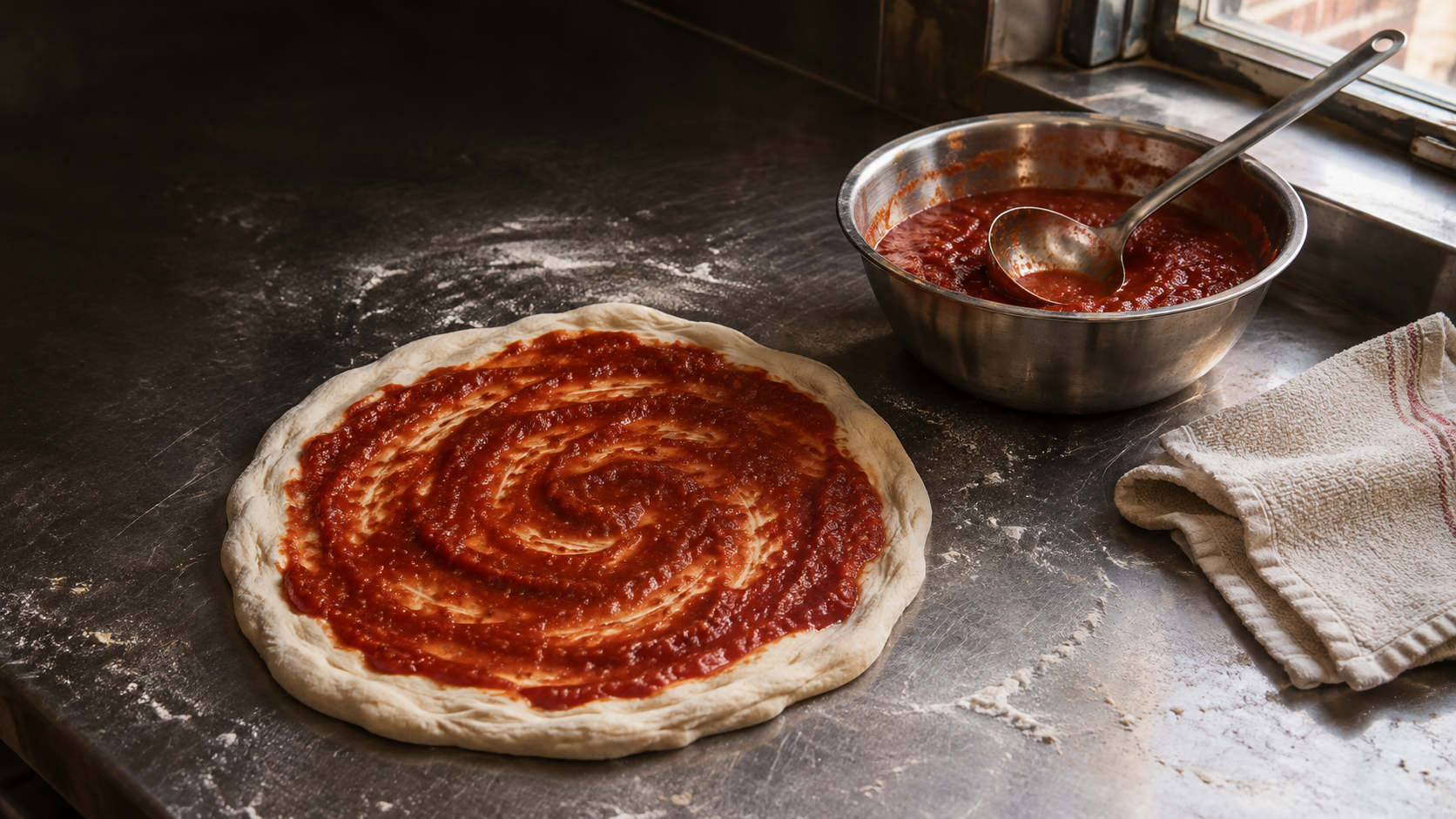
You use the same dough, the same cheese, and the same ladle. Yesterday the sauce spread easily. Today you have to push it around the dough, and one pizza looks noticeably wetter than the next.
Before you change the recipe, ask a more useful question: what actually stayed the same?
The ladle may be identical. The amount it delivered may not be. The tomato product may have the same name while its texture, preparation, or temperature differs.
Pizza sauce consistency is both an ingredient issue and a production issue. Understanding the difference helps you improve the pizza without making unnecessary changes.
A new pizza sauce still needs a pizza test
On October 27, 2026, Hoboken Farms announced a pizza sauce addition to its lineup, describing it as full-bodied and chunky. That is a timely example of a product positioned specifically for pizza. It is not a comparative performance test, and I have not tested this sauce for this article. [1]
As a food scientist and chef, I want to know how a sauce performs after it leaves the container. Can it be portioned consistently? Does it spread the way the operator needs? How does it taste with the dough and cheese after baking?
A label can help you choose what to try. Your pizza determines what works.
Three questions that should not be treated as one
How concentrated is it?
A refractometer's Brix reading can help track soluble-solids concentration. In a mixed sauce, that reading is not simply a sugar percentage: dissolved salts, acids, and other ingredients also contribute. Nor does it measure all the insoluble tomato material. Use a consistent sampling method and the instrument manufacturer's instructions. [2]
The useful question is whether a reading helps you monitor your particular formula. A higher number is not automatically a better sauce.
How does it move?
A sauce can have body, visible particles, or resistance to spreading that a concentration reading does not describe on its own.
USDA's published tomato-product consistency method identifies tomato variety, processing, particle size, and concentration method as relevant variables. Its Bostwick procedure measures flow under specified conditions. That makes consistency a separate question from soluble solids. [3]
A supplier example shows why the details matter: Morning Star specifies one puree at 15–17% natural tomato soluble solids and separately lists a Bostwick limit measured without dilution for 30 seconds at 20°C. Those are specifications for that product, not a universal target for finished pizza sauce. [4]
How much reaches the dough?
A ladle is a portioning tool. It does not guarantee the weight deposited.
How full you scoop it, how long you let it drain, how much remains on the utensil, and whether you give the pizza an extra swipe can all affect the portion.
Weigh a few normal portions before concluding that the sauce formula needs work.
Why “just add water” is an incomplete answer
Water can make a sauce easier to distribute. It also changes the amount of tomato, salt, seasoning, and other ingredients in each gram of finished sauce.
Here is a hypothetical formulation example, not a recommendation:
Start with 1,000 grams of sauce. Add 100 grams of water. The original sauce now accounts for about 90.9% of the new mixture.
If you continue applying the same weight, each portion contains about 9.1% less of every ingredient contributed by the original sauce. Adding 10% of the starting weight as water did not produce a 10% reduction in concentration, because the final batch weighs 1,100 grams.
That may be an acceptable change. It may also make the sauce taste weaker than intended.
Record the water addition and evaluate the baked pizza. Do not fix spreadability without checking flavor and portioning.
Start with a portion check
Before comparing brands or changing the recipe, run this small check with your current sauce:
- Prepare and mix it as you normally would.
- Record its temperature and how long it has been held under your established storage procedure.
- Tare a clean container on a suitable scale.
- Deposit one normal portion using your usual ladle and technique.
- Record the weight, reset, and repeat for ten portions.
- If several people make pizzas, repeat with each operator.
This is a proposed diagnostic exercise. There are no Green Light Lab results to report yet.
Look at the average and the range. Ten portions clustered closely together tell a different story from ten portions that vary widely around the same average.
If portions vary, first standardize the scooping, leveling, and depositing method. The best tool for your operation might be a ladle, spoodle, or another dispenser. Choose it through use, not its label alone.
Then compare sauces at equal weight
Once portioning is controlled, compare your current sauce with one candidate.
Use the same pizza style, diameter, dough formula and dough-ball weight. Keep cheese, toppings, opening technique, and baking conditions as consistent as practical. Record actual conditions rather than assuming they matched.
Use equal sauce weights for the initial test. That is a comparison control, not a claim that every sauce should ultimately use the same portion.
Evaluate:
- Time and effort required to spread the sauce.
- Coverage and any bare or heavily sauced areas.
- Flavor balance in the baked pizza.
- Wet patches, topping movement, and slice handling.
- The eating experience at the same elapsed time after baking.
Repeat before choosing a winner. Alternate the order of baking where practical so one sauce does not always get the first bake in a fully recovered oven.
If a candidate seems promising but needs a different portion, run a second test that changes only its portion weight. This separates “how does it compare at the same weight?” from “what is the best way to use it?”
There is no universal sauce weight
A 12-inch diameter does not establish the ideal amount of sauce.
A thin center, a thicker pan crust, an upside-down build, and a pizza with sauce applied after baking create different requirements. Cheese and topping choices matter too.
Set a target for your finished pizza, then establish a sauce portion that delivers it consistently. Avoid adopting someone else's number without understanding their style and process.
This is the same principle behind choosing fresh or low-moisture mozzarella: an ingredient earns its place through the result you need.
Small portion differences become operational differences
Suppose a hypothetical operation intends to apply 80 grams of sauce but averages 95 grams.
Across 100 pizzas, that is 1.5 kilograms of additional sauce. If the sauce costs $3 per kilogram, the additional ingredient cost is $4.50. Those are example inputs, not my purchasing costs or a recommended serving size.
The financial calculation is only part of the decision. If the additional sauce improves the pizza enough to justify its cost, it may belong in the specification. If it produces inconsistency without improving the experience, it deserves attention.
At Underground Pizza Truck, I have described my value proposition in terms of ingredients, handmade dough, and the finished experience. Portion control supports that promise by helping one customer's pizza resemble the next.
The Green Light Lab takeaway
Myth: A thicker sauce or higher Brix reading automatically means a better pizza.
Fact: Concentration, flow, flavor, and portion weight answer different questions. Evaluate them together in your own pizza.
Start by weighing what you already serve. Then change the ingredient or process with a clear reason.
For a repeatable approach to pizza testing, explore Pizza Dough by the Numbers and The Green Light Lab Pizza Dough Logbook. Although this test focuses on sauce, the discipline is the same: define the variable, record the process, and compare the result.
If you are developing a sauce or moving a recipe into production, contact Fire In The Kitchen to discuss formulation and process development.
© 2026 Ray Sierengowski / Fire In The Kitchen, LLC. All rights reserved. For republication permission, contact ray@fireinthekitchen.com.
Article sources
- Hoboken Farms pizza sauce announcement, October 27, 2026. Primary brand announcement, used only to establish the launch and positioning, not prove comparative quality.
- ATAGO: Introduction to refractometers and Brix. Instrument manufacturer's explanation of Brix and mixed soluble ingredients.
- USDA: Determination of Consistency of Tomato Products. Historical technical method still hosted by USDA; cited for measurement principles, not as a newly issued standard.
- Morning Star: Tomato Puree, 1.07 Specific Gravity. Product-specific soluble-solids and flow specifications.